

CBD crumble is one of the more distinctive products in the world of hemp-derived concentrates. It is dry, golden and breaks apart at the lightest touch, which sets it apart from glassy shatter or sticky wax. But what is it made of, how does it get that texture, and what should you check before you buy?
This guide brings everything together. It explains what CBD crumble is, how it is made, the different extract types it can be based on, how it compares with other concentrates, and what UK buyers should know about quality and the law. Where a topic needs more depth, we point you to a dedicated article in this series.
What Is CBD Crumble?
CBD crumble is a concentrated form of cannabidiol (CBD) taken from the hemp plant. Rather than keeping cannabinoids inside the plant material, as hemp flower does, crumble is the refined extract left once those compounds have been separated out and dried into a solid.
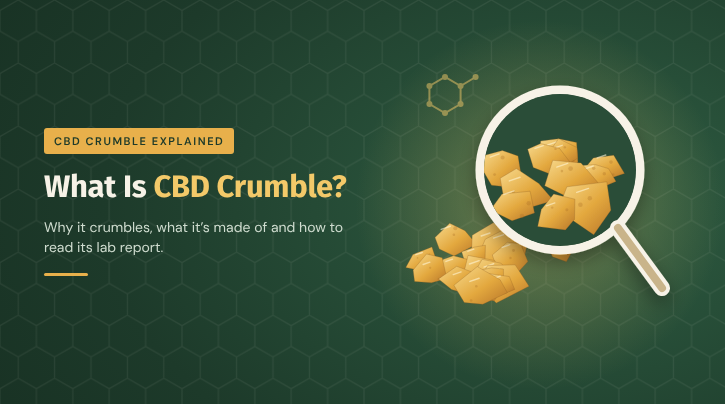
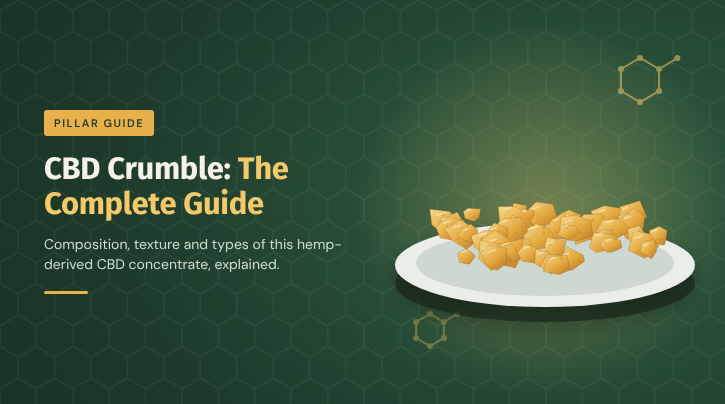
The name comes from its texture. Good crumble is dry, matte and slightly porous, a bit like a honeycomb or a soft biscuit. It breaks into small pieces rather than bending or stretching.
Crumble belongs to a wider family of CBD concentrates, alongside shatter, wax, budder, distillate and isolate. These products can start from similar hemp extracts. What separates them is mainly how the extract is processed after extraction, which shapes its texture and, to some extent, its composition.
For a closer look at the science behind the texture, read our article on what CBD crumble is and why it crumbles.
How Is CBD Crumble Made?
Every CBD crumble starts as raw hemp and ends as a refined concentrate. In between are two broad stages: extraction, then the processing that gives the extract its final consistency.
Understanding Hemp Extraction
Extraction uses a solvent to pull cannabinoids and terpenes away from the plant material. The most common methods are:
- Hydrocarbon extraction, using solvents such as butane or propane
- Supercritical CO₂ extraction, using carbon dioxide under pressure
- Ethanol extraction, using food-grade alcohol
The result is a crude hemp-derived CBD extract. Producers often refine it further. One common step is winterisation, where the extract is mixed with ethanol and chilled so that fats, plant waxes and lipids can be filtered out.
Each method has trade-offs in efficiency, cost and how well it keeps delicate terpenes. Our guide to CBD extract types explains these production methods in more detail.
How Extract Consistency Is Formed
The texture of a concentrate is largely decided after extraction, during a stage called purging. The extract is gently heated, usually in a vacuum oven, to remove leftover solvent.
Several factors shape the final consistency:
- Purging temperature and time
- Moisture and terpene content
- How much the extract is agitated or whipped
- The starting plant material and its cannabinoid make-up
Crumble is generally associated with a longer, gentler purge that leaves a dry, low-moisture solid. Small changes to the same process can produce shatter, budder or wax instead. Methods differ between producers, and many keep their exact process private, so texture alone tells you little about how a product was made.
What Does CBD Crumble Look Like?
CBD crumble is usually opaque, with a colour ranging from pale yellow to deep golden amber. It looks dry rather than glossy, and it tends to fall apart into small chunks or a coarse powder when handled.
Compared with other concentrates, crumble is:
- Less sticky than wax or budder
- Softer and less brittle than shatter
- More solid than distillate, which is a thick oil
Warmth and humidity can change its texture over time, so crumble is normally stored in an airtight container, away from heat and light. Colour can hint at the starting material or processing, but it is not a reliable measure of quality on its own. The lab report is a much better guide.
CBD Crumble Full Spectrum Explained
The word “spectrum” describes which hemp compounds remain in an extract. Knowing the difference helps you understand what a label is telling you, especially when looking at CBD crumble full spectrum products.
Full-Spectrum Extracts
A full-spectrum hemp extract keeps a broad range of the plant’s natural compounds. This includes CBD, minor cannabinoids such as CBG, CBN and CBC, terpenes and, typically, trace amounts of THC.
That last point matters in the UK. THC is a controlled substance, so whether a full-spectrum product can be sold lawfully depends on the exempt product rules covered later in this guide. Always check the Certificate of Analysis (COA) for the THC result.
Broad-Spectrum Extracts
Broad-spectrum extracts aim to keep a similar range of cannabinoids and terpenes, but with THC removed or reduced below the laboratory’s detection limit. On a lab report, this usually shows as “ND” (not detected). A “THC-free” claim should always be backed by a COA that shows this result.
CBD Isolate
CBD isolate is cannabidiol that has been purified on its own, usually as a white crystalline powder. It contains very little else from the plant. Even so, the UK’s Advisory Council on the Misuse of Drugs has noted that isolates can still carry traces of other cannabinoids, so testing still matters.
Some crumble-style products are made by combining isolate with terpenes or other extracts. The label and COA should make clear which type of extract a product is based on. You can see what pure isolate looks like in our CBD isolate collection. For a full breakdown of the three types, see CBD Extracts Explained.
CBD Crumble vs Other CBD Concentrates
Most CBD concentrates come from similar raw extracts. The main differences are in texture, handling and processing. If you want to see a glass-like format for comparison, take a look at our CBD shatter range.
| Concentrate | Texture | What sets it apart |
|---|---|---|
| Crumble | Dry, porous, breaks apart easily | Low moisture; easy to portion |
| Wax | Soft, sticky, pliable | Higher moisture; “wax” is also used as a catch-all name for concentrates |
| Budder | Creamy, smooth, whipped | Agitated during purging for a butter-like feel |
| Shatter | Hard, glassy, brittle | Left undisturbed so it sets clear and snaps |
| Distillate | Thick, viscous oil | Refined through distillation; often very little terpene content |
| Isolate | Fine white powder or crystals | Purified CBD with minimal other compounds |
Texture does not tell you how strong a product is or what it contains. Two concentrates with very different textures can have similar cannabinoid profiles, and two crumbles can differ widely. Our article on how CBD crumble compares with CBD wax looks at the closest comparison in detail.
What Should You Know About CBD Crumble Quality?
Quality comes down to what is in the product, how it was made and whether that information is verified. Three areas are worth checking every time.
Cannabinoid Profile
The cannabinoid profile shows how much CBD and other cannabinoids a product contains. It is usually listed as a percentage by weight or in milligrams per gram (mg/g).
Look for:
- Total CBD, which may include CBDA, the raw acid form of CBD that converts to CBD when heated
- Minor cannabinoids, such as CBG or CBN, if the product is full- or broad-spectrum
- THC and THCA results, which should be clearly reported
The profile should match what the product page and label claim. If a product says “full spectrum” but shows only CBD, or claims a CBD percentage the lab report does not support, treat that as a warning sign.
Third-Party Lab Reports
A Certificate of Analysis is a lab report showing what a specific batch contains. It is most useful when it comes from an independent, third-party laboratory rather than the manufacturer itself.
A trustworthy COA should show:
- The laboratory’s name and, ideally, its ISO/IEC 17025 accreditation
- A batch number that matches the product you are buying
- A recent test date
- Cannabinoid potency results
- Screens for residual solvents, heavy metals, pesticides and microbes, where tested
Residual solvent testing is especially relevant for concentrates, because solvents are part of how they are made. Our guide on how to read a Certificate of Analysis walks through each section of a typical report.
Product Ingredients and Labelling
Clear labelling is a good sign of a responsible supplier. A well-labelled CBD crumble should state:
- The extract type (full-spectrum, broad-spectrum or isolate-based)
- CBD content per gram or per container
- A batch number linked to the COA
- Any added ingredients, such as hemp or botanical terpenes, and where they come from
- Storage guidance and manufacturer details
Be cautious of any CBD product that claims to treat, cure or prevent a health condition. In the UK, products making medicinal claims are regulated as medicines and need a licence from the MHRA. A consumer CBD concentrate should not be marketed in that way.
Is CBD Crumble Legal in the UK?
CBD on its own is not a controlled drug in the UK. Cannabis and THC, however, are controlled as Class B drugs under the Misuse of Drugs Act 1971. Because extracting pure CBD is difficult, many CBD products contain small amounts of controlled cannabinoids such as THC.
The Home Office’s position is that a product containing a controlled cannabinoid is itself controlled, unless it meets all three parts of the “exempt product” definition in the Misuse of Drugs Regulations 2001:
- It is not designed to give a controlled drug to a human or animal.
- The controlled drug cannot easily be recovered from it.
- No single component part contains more than one milligram of the controlled drug.
The Home Office does not check or approve individual products against these criteria. Responsibility sits with the businesses that make and sell them.
A common myth is that any CBD product with under 0.2% THC is automatically legal. That figure relates to the licensing of industrial hemp cultivation, not to finished CBD products. For UK buyers, the safest approach is to choose CBD crumble backed by a recent, batch-matched COA that clearly reports THC and other controlled cannabinoids.
The rules continue to change. In May 2026, the Home Office confirmed it will move to control THCA and a group of semi-synthetic cannabinoids as Class B drugs. This guide covers CBD only, and is general information rather than legal advice.
Frequently Asked Questions
Is CBD crumble the same as CBD wax?
Not quite. Both are CBD concentrates, but crumble is drier and breaks apart, while wax is softer and stickier. “Wax” is also sometimes used as a general name for concentrates, so labels can overlap. See CBD Crumble vs CBD Wax for the full comparison.
Does CBD crumble contain THC?
It depends on the extract. Full-spectrum crumble is likely to contain traces of THC, while broad-spectrum and isolate-based products aim for none detected. The product’s COA is the only reliable way to check.
Is all CBD crumble full spectrum?
No. CBD crumble can be made from full-spectrum, broad-spectrum or isolate-based extracts. The label should say which, and the cannabinoid profile on the lab report should support it.
How should CBD crumble be stored?
Keep it in an airtight container in a cool, dark place. Heat, light and humidity can change its texture and may affect its terpene content over time.
What makes CBD crumble different from CBD flower?
CBD flower is the dried plant, with cannabinoids still inside the plant material. Crumble is an extract, with cannabinoids separated from the plant and concentrated, so its composition per gram is very different.
Where can I buy CBD crumble in the UK?
CBD crumble is sold by a range of UK retailers. Whoever you buy from, check for a batch-matched third-party COA, clear labelling and no medical claims. You can browse our CBD crumble collection or explore our wider range of hemp-derived extracts.