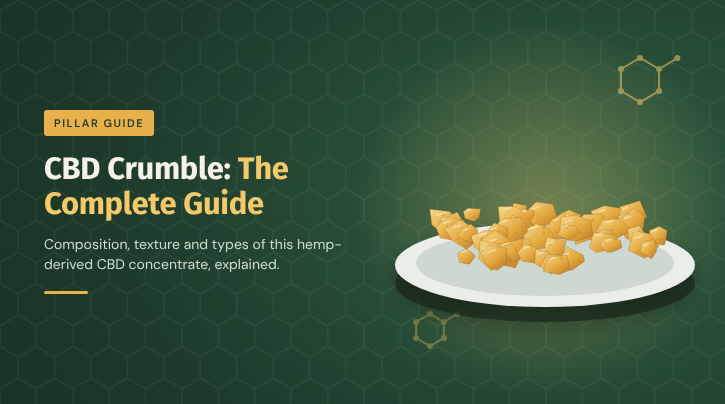

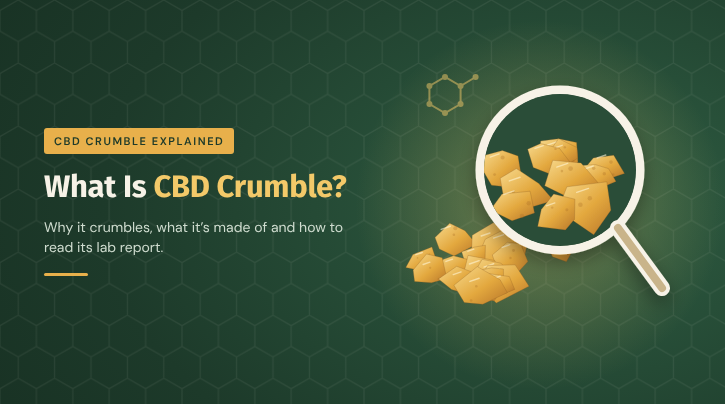

If you have seen CBD crumble for the first time, its texture is probably what stood out. It looks dry and golden, and it falls apart in your fingers. But what is it actually made of, and why does it behave so differently from other hemp extracts?
This article focuses on the CBD crumble extract itself: what gives it that crumbly consistency, what compounds it contains, and how to make sense of its lab report. For a wider overview covering types, quality and UK law, see our complete CBD crumble guide.
Understanding CBD Crumble
CBD crumble is a type of CBD concentrate. It is made by extracting cannabinoids and terpenes from hemp, refining that extract and then drying it into a solid that breaks apart easily.
The word “concentrate” is the key. Hemp flower holds its cannabinoids inside plant material, mixed with fibre, chlorophyll and moisture. A concentrate removes most of that plant matter, which means far more cannabinoid content per gram.
Crumble sits alongside other concentrates such as shatter, wax, budder and distillate. These can start from similar raw hemp extracts. What makes crumble different is mostly what happens after extraction.
Why Does CBD Crumble Have a Crumbly Texture?
Crumble gets its texture from how the extract is dried and how its molecules settle. Three factors play the biggest role.
- Low moisture. After extraction, the concentrate is purged to remove leftover solvent. This is usually done with gentle heat in a vacuum oven. Crumble is generally purged long enough to leave very little moisture behind, which makes it dry rather than sticky.
- Terpene content. Terpenes are the aromatic compounds in hemp, and they are naturally oily. Extracts with higher terpene levels tend to be softer and more pliable. Crumble usually has lower terpene content than softer concentrates such as budder or sauce, which helps it stay firm.
- Molecular structure. In general terms, when cannabinoids in an extract stay evenly spread and undisturbed, the result can set clear and glass-like, as with shatter. When heat, moisture or movement cause the molecules to start forming tiny crystal structures, the extract becomes opaque and loses its glassy snap. Crumble is one result of this process, often described as nucleation.
Producers balance these factors differently, and many keep their exact methods private. That is why two crumbles can look and feel slightly different, even when both are labelled the same way.
What Is CBD Crumble Made Of?
At its simplest, a CBD crumble extract contains three groups of compounds:
- Cannabinoids, mainly cannabidiol (CBD), plus smaller amounts of others depending on the extract type
- Terpenes, which give hemp its aroma and flavour
- Trace plant compounds, such as some lipids or flavonoids that remain after refining
The exact mix depends on the starting hemp, the extraction method and the extract type. A crumble made from a full-spectrum hemp extract will contain a wider range of cannabinoids than one based on CBD isolate. Some crumble-style products also have terpenes added after extraction. A clear label should say whether those terpenes are hemp-derived or botanical.
The extraction itself usually uses a solvent such as butane, propane, CO₂ or ethanol. Purging aims to remove that solvent, which is why residual solvent testing is an important part of any crumble lab report.
Understanding Cannabinoids and Terpenes
Hemp produces more than a hundred cannabinoids and a wide range of terpenes. Only a handful usually appear in meaningful amounts in a CBD crumble.
| Compound | Type | What you may see on a label or report |
|---|---|---|
| CBD | Cannabinoid | The main cannabinoid; usually the largest figure |
| CBDA | Cannabinoid acid | The raw form of CBD, which converts to CBD when heated |
| CBG, CBN, CBC | Minor cannabinoids | Present in full- and broad-spectrum extracts in smaller amounts |
| THC, THCA | Controlled cannabinoids | Should be clearly reported; often “ND” (not detected) in broad-spectrum and isolate-based products |
| Myrcene, limonene, pinene, caryophyllene | Terpenes | Shape aroma and flavour; levels vary by strain and process |
These compounds describe what is in the product. They are not a guide to how it will affect you, and responsible suppliers should not make health or wellbeing claims about them.
If you want to understand how full-spectrum, broad-spectrum and isolate extracts differ, our article on CBD extract types and composition covers each one in detail.
CBD Crumble vs Other Hemp Extracts
Crumble is easiest to understand next to its closest relatives. The main differences are texture and moisture, rather than the source plant.
- Shatter is hard and glass-like. It is left undisturbed during purging so it sets clear. See our CBD shatter for an example.
- Wax and budder are softer and stickier, usually with more moisture or terpenes.
- Distillate is a thick oil, refined through distillation and often low in terpenes.
- Isolate is a white crystalline powder of purified CBD, like the products in our CBD isolate collection.
Crumble sits between wax and shatter: firmer and drier than wax, but softer and less brittle than shatter. For a side-by-side look at the closest comparison, read CBD crumble vs CBD wax.
You can see the different extract formats together in our range of hemp-derived extracts.
How to Read a CBD Extract Lab Report
A Certificate of Analysis (COA) is the most reliable way to know what a CBD crumble extract contains. It is a report from a laboratory showing the results for a specific batch.
When reading one for crumble, focus on these points:
- Batch number. It should match the batch on the product or its listing. A COA for a different batch tells you nothing about yours.
- Laboratory details. An independent, third-party lab is more reliable than in-house testing. ISO/IEC 17025 accreditation is a good sign.
- Test date. A recent date is better, as composition can change with time and storage.
- Cannabinoid potency. Check CBD, CBDA and the minor cannabinoids, usually shown as a percentage or in mg/g. Make sure the figures support the product’s claims.
- THC results. These should be listed clearly, whether as a figure or as “ND” with the lab’s detection limit.
- Residual solvents. This matters most for concentrates. The report should show that any solvent used in extraction has been removed to within the lab’s limits.
- Contaminants. Heavy metals, pesticides and microbial tests show that the extract is clean, where these are included.
If a supplier cannot provide a COA, or the report looks incomplete or out of date, that is a reason to look elsewhere. For a full walk-through of every section, see our guide to reading a Certificate of Analysis.
What Should UK Consumers Know?
CBD itself is not a controlled drug in the UK, but THC and several other cannabinoids are. A CBD product that contains controlled cannabinoids is only outside drug controls if it meets the Home Office’s exempt product definition. Part of that definition is that no single component part contains more than one milligram of a controlled drug.
For UK buyers, that makes a few habits worthwhile:
- Check the COA before buying, especially the THC and THCA results
- Be wary of the “0.2% THC” claim. That figure relates to hemp cultivation licensing, not to finished products
- Avoid products making medical claims. In the UK, these are regulated as medicines
- Store crumble properly, in an airtight container away from heat and light
- Speak to a GP or pharmacist if you take medication or have health concerns before using any CBD product
This is general information, not legal advice. Our complete CBD crumble guide explains the UK legal position in more detail.
Frequently Asked Questions
What is a CBD crumble extract?
It is a hemp-derived CBD concentrate that has been refined and dried into a crumbly solid. It contains cannabinoids, mainly CBD, along with terpenes and small amounts of other plant compounds.
Why is CBD crumble crumbly rather than sticky?
Crumble has low moisture and usually lower terpene content than softer concentrates. Its molecules have also begun to form tiny crystal structures, which makes it opaque and dry rather than glassy or sticky.
Is CBD crumble stronger than CBD flower?
Crumble is a concentrate, so it usually contains far more cannabinoids per gram than flower. The exact figures vary by product, so check the cannabinoid results on the COA.
Does CBD crumble have a smell?
Many crumbles have a noticeable hemp aroma from their terpenes. The strength depends on how many terpenes survived processing or were added back.
Can I see what is in a CBD crumble before I buy it?
Yes. A reputable supplier should provide a batch-matched, third-party COA. You can explore products and their lab reports in our CBD crumble collection.